
#10740First Love!!!
★★★Abul is not the best student in his class; neither is he the best player in his team. Not that he is bad; he is really good, but unfortunately not the best.
Last semester our "not quite the best" Abul took a course on algorithms. In one of the assignments he was required to find the shortest path from a given vertex x to another vertex y in a weighted directed graph. As you have probably already guessed, he rarely managed to find the shortest path; instead he always ended up finding the k-th (2 ≤ k ≤ 10) shortest path from x to y. If he was fortunate enough and the shortest k paths from x to y had the same length, he was given credit for his solution.
For example, for the graph on the right, Abul was asked to find the shortest path from vertex 5 to vertex 2.
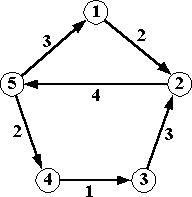 The shortest 7 paths from
vertex 5 to vertex 2 are listed below in non-decreasing order of length.
For this graph Abul was able to find the 5-th shortest path which could
be either 5 → 4 → 3 → 2 → 5 → 1 → 2 or 5 → 1 → 2 → 5 → 4 → 3 → 2, each with length 15.
範例輸入 1
3 3
1 3 4
1 3 3
1 2 4
2 3 5
5 6
5 2 5
1 2 2
2 5 4
3 2 3
4 3 1
5 1 3
5 4 2
2 2
1 2 3
1 2 5
2 2 2
0 0
範例輸出 1
-1
15
9
Pro 專屬功能: 查看這題在歷屆 CPE 出現過幾次 — 升級以解鎖.