#10813Traditional BINGO
★★時間限制:2000 毫秒記憶體限制:64 MB
Traditional BINGO is played in person in a large hall. Players meet at the hall, pay a fee to get in, then the games begin. A night of BINGO consists of many BINGO games played continuously, one after another.
A single BINGO game proceeds like this: Each player has a number of BINGO cards (players can usually play any number of cards). Each BINGO card has 5 rows and 5 columns thus providing 25 spaces.
The columns are labeled from left to right with the letters: 'B', 'I', 'N', 'G', 'O'. With one exception (the center space is "free") the spaces in the card are assigned values as follows:
- Each space in the 'B' column contains a number from 1 - 15.
- Each space in the 'I' column contains a number from 16 - 30.
- Each space in the 'N' column contains a number from 31 - 45.
- Each space in the 'G' column contains a number from 46 - 60.
- Each space in the 'O' column contains a number from 61 - 75.
Furthermore, a number can appear only once on a single card.
Here's a sample BINGO card:
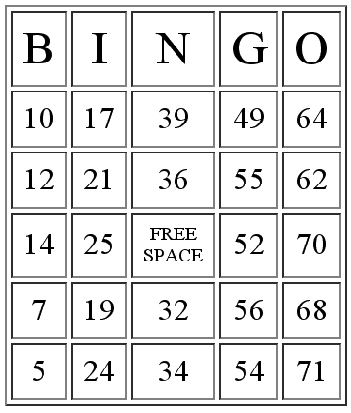
範例輸入 1
1
10 17 39 49 64
12 21 36 55 62
14 25 52 70
7 19 32 56 68
5 24 34 54 71
1 2 3 4 5 6 7 8 9 10
11 12 13 14 15 16 17 18 19 20
21 22 23 24 25 26 27 28 29 30
31 32 33 34 35 36 37 38 39 40
41 42 43 44 45 46 47 48 49 50
51 52 53 54 55 56 57 58 59 60
61 62 63 64 65 66 67 68 69 70
71 72 73 74 75
範例輸出 1
BINGO after 14 numbers announced
Pro 專屬功能: 查看這題在歷屆 CPE 出現過幾次 — 升級以解鎖.