
#122Trees on the level
★★★Trees are fundamental in many branches of computer science (Pun definitely intended). Current state-of-the art parallel computers such as Thinking Machines’ CM-5 are based on fat trees. Quad- and octal-trees are fundamental to many algorithms in computer graphics.
This problem involves building and traversing binary trees.
Given a sequence of binary trees, you are to write a program that prints a level-order traversal of each tree. In this problem each node of a binary tree contains a positive integer and all binary trees have have fewer than 256 nodes.
In a level-order traversal of a tree, the data in all nodes at a given level are printed in left-to-right order and all nodes at level k are printed before all nodes at level k + 1.
For example, a level order traversal of the tree on the right is: 5, 4, 8, 11, 13, 4, 7, 2, 1.
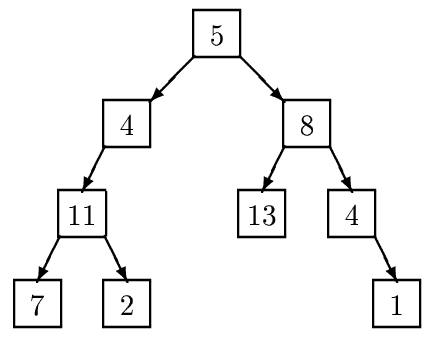
In this problem a binary tree is specified by a sequence of pairs ‘(n,s)’ where n is the value at the node whose path from the root is given by the string s. A path is given be a sequence of ‘L’s and ‘R’s where ‘L’ indicates a left branch and ‘R’ indicates a right branch. In the tree diagrammed above, the node containing 13 is specified by (13,RL), and the node containing 2 is specified by (2,LLR). The root node is specified by (5,) where the empty string indicates the path from the root to itself. A binary tree is considered to be completely specified if every node on all root-to-node paths in the tree is given a value exactly once.
範例輸入 1
(11,LL) (7,LLL) (8,R)
(5,) (4,L) (13,RL) (2,LLR) (1,RRR) (4,RR) ()
(3,L) (4,R) ()
範例輸出 1
5 4 8 11 13 4 7 2 1
not complete
Pro 專屬功能: 查看這題在歷屆 CPE 出現過幾次 — 升級以解鎖.