
#1234RACING
★★★★Singapore will host a Formula One race in 2008. The race will be held on a 5.067km long street circuit, consisting of 14 left hand turns and 10 right hand turns. In the run up to the F1 race, the number of illegal night street racing activities have been on the rise. Such races consists of several rounds around a designated street circuit.
The authorities would like to deploy a new vehicle monitoring system in order to catch these illegal racers. The system consists of a number of cameras mounted along various roads. For the system to be effective, there should be at least one camera along each of the possible circuits.
The Singapore road system can be represented as a series of junctions and connecting bidirectional roads (see Figure 5).
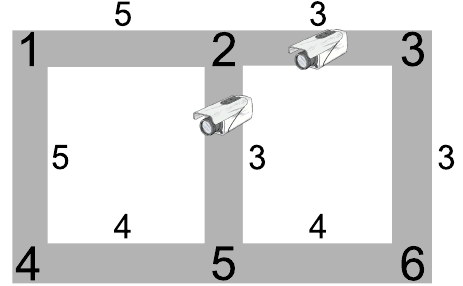 A possible racing circuit consists of a start junction followed by a path consisting of three or more roads that eventually leads back to the start junction. Each road in a racing circuit can be traversed only in one direction, and only once.
Your task is to write a program that computes the optimal placement of the vehicle-monitoring cameras. You will be provided with a description of a connected road network to be monitored in terms of the roads and junctions. The junctions are identified by the bigger numbers in Figure 5. A camera can be deployed on the roads (and not the junctions).
範例輸入 1
1
6 7
1 2 5
2 3 3
1 4 5
4 5 4
5 6 4
6 3 3
5 2 3
0
範例輸出 1
6
Pro 專屬功能: 查看這題在歷屆 CPE 出現過幾次 — 升級以解鎖.