#1366Martian Mining
★★★The NASA Space Center, Houston, is less than 200 miles from San Antonio, Texas (the site of the ACM Finals this year). This is the place where the astronauts are trained for Mission Seven Dwarfs, the next giant leap in space exploration. The Mars Odyssey program revealed that the surface of Mars is very rich in yeyenum and bloggium. These minerals are important ingredients for certain revolutionary new medicines, but they are extremely rare on Earth. The aim of Mission Seven Dwarfs is to mine these minerals on Mars and bring them back to Earth.
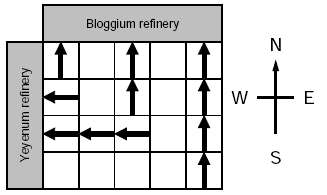
The Mars Odyssey orbiter identified a rectangular area on the surface of Mars that is rich in minerals. The area is divided into cells that form a matrix of n rows and m columns, where the rows go from east to west and the columns go from north to south. The orbiter determined the amount of yeyenum and bloggium in each cell. The astronauts will build a yeyenum refinement factory west of the rectangular area and a bloggium factory to the north. Your task is to design the conveyor belt system that will allow them to mine the largest amount of minerals.
There are two types of conveyor belts: the first moves minerals from east to west, the second moves minerals from south to north. In each cell you can build either type of conveyor belt, but you cannot build both of them in the same cell. If two conveyor belts of the same type are next to each other, then they can be connected. For example, the bloggium mined at a cell can be transported to the bloggium refinement factory via a series of south-north conveyor belts.
範例輸入 1
4 4
0 0 10 9
1 3 10 0
4 2 1 3
1 1 20 0
10 0 0 0
1 1 1 30
0 0 5 5
5 10 10 10
0 0
範例輸出 1
98
Pro 專屬功能: 查看這題在歷屆 CPE 出現過幾次 — 升級以解鎖.