
#1371Period
★★★★Given two strings A and B over an alphabet Σ, the edit distance between A and B is the minimum number of edit operations needed to convert A into B. The three edit operations are the following:
(i) change: replace one character of A by another single character of B.
(ii) deletion: delete one character from A.
(iii) insertion: insert one character of B into A.
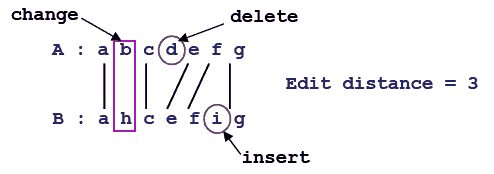
For example, the following figure shows that the edit distance between the strings A=abcdefg and B=ahcefig is 3. The edit operations are a change (i.e., replacing b of A by h of B), a deletion (i.e., deleting d from A), and an insertion (i.e., inserting i of B into A).
We now define a period of a repetitive string as follows: The string p is called the exact period of a string x if x can be written as x = p, where k ≥ 1 and p is the shortest string. For example, if x = abababab then x = (abababab) = (abab) = (ab). Thus, the string ab is the exact period of x.
範例輸入 1
3
abc
abcdabcabb
abab
abababababab
xyz
abcdefghikjlmn
範例輸出 1
1
0
3
Pro 專屬功能: 查看這題在歷屆 CPE 出現過幾次 — 升級以解鎖.