#657The Die is Cast
★★★InterGames is a high-tech startup company that specializes in developing technology that allows users to play games over the Internet. A market analysis has alerted them to the fact that games of chance are pretty popular among their potential customers. Be it Monopoly, ludo or backgammon, most of these games involve throwing dice at some stage of the game.
Of course, it would be unreasonable if players were allowed to throw their dice and then enter the result into the computer, since cheating would be way to easy. So, instead, InterGames has decided to supply their users with a camera that takes a picture of the thrown dice, analyzes the picture and then transmits the outcome of the throw automatically.
For this they desperately need a program that, given an image containing several dice, determines the numbers of dots on the dice.
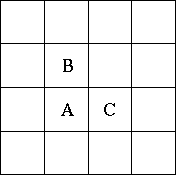
We make the following assumptions about the input images. The images contain only three different pixel values: for the background, the dice and the dots on the dice. We consider two pixels connected if they share an edge — meeting at a corner is not enough. In the figure, pixels A and B are connected, but B and C are not.
範例輸入 1
30 15
..............................
..............................
...............*..............
...*****......****............
...*X***.....**X***...........
...*****....***X**............
...***X*.....****.............
...*****.......*..............
..............................
........***........******.....
.......**X****.....*X**X*.....
......*******......******.....
.....****X**.......*X**X*.....
........***........******.....
..............................
0 0
範例輸出 1
Throw 1
1 2 2 4
Pro 專屬功能: 查看這題在歷屆 CPE 出現過幾次 — 升級以解鎖.